Production Problems It Solves
A direct conveying path blocked by columns or vessels
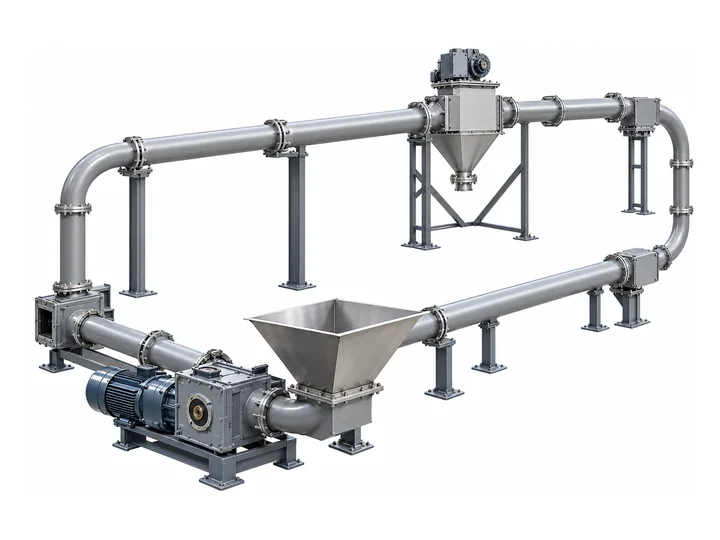
Defined bends connect the inlet and receiver around the obstruction within a fixed circuit.
Several open handovers at route changes
The chain and discs continue through the enclosed bends instead of discharging at every direction change.
Where It Fits in Your Plant
Existing production lines
Connect an ingredient hopper to a mixer around established equipment while keeping bend inspection points accessible.
Chemical and pellet transfer
Route suitable dry solids between offset process points. Every bend adds resistance and wear contact; the circuit is a supported tube arrangement, not a freely bendable hose.
How the Curved Pipe Chain Conveyor Works
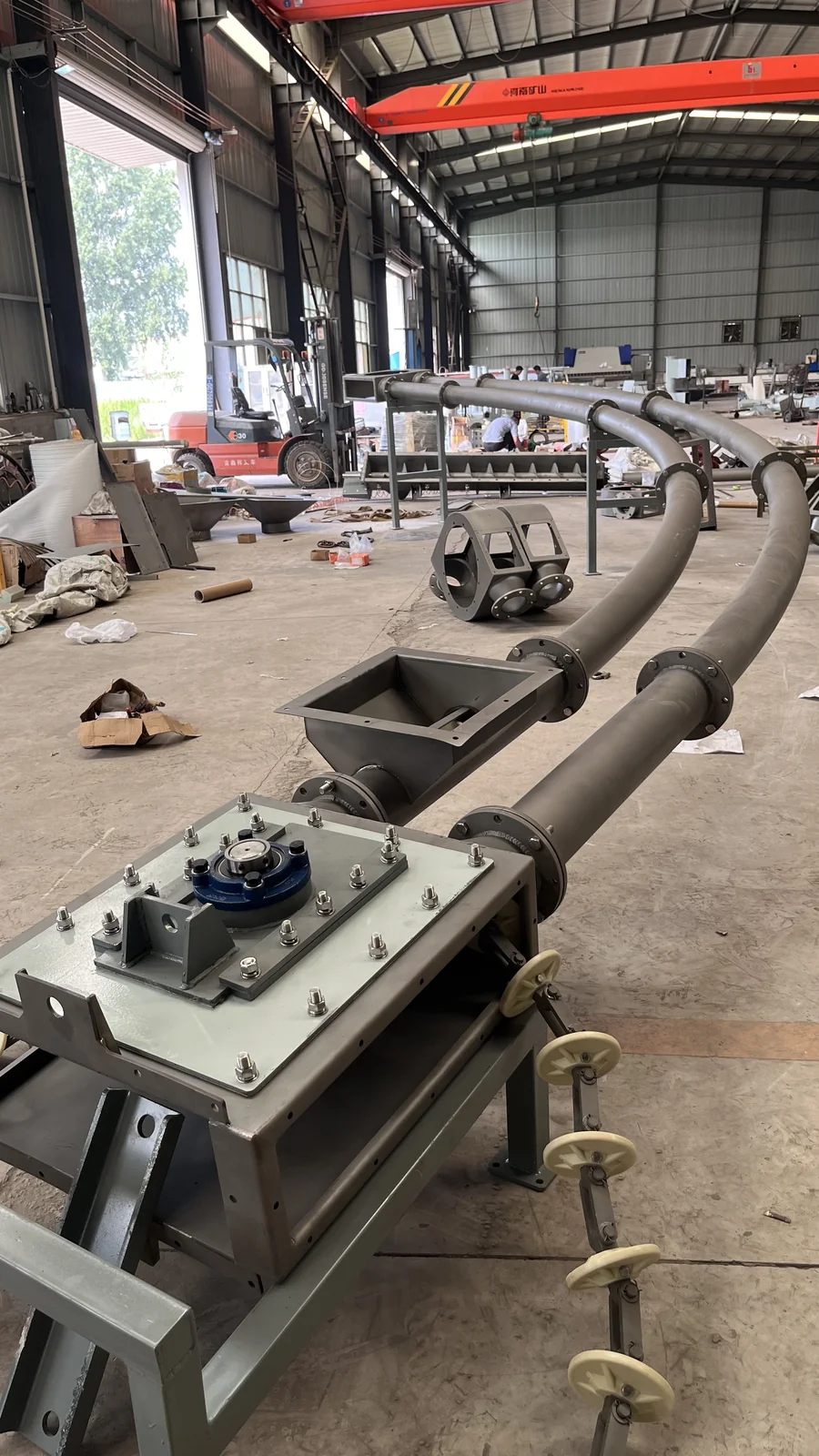
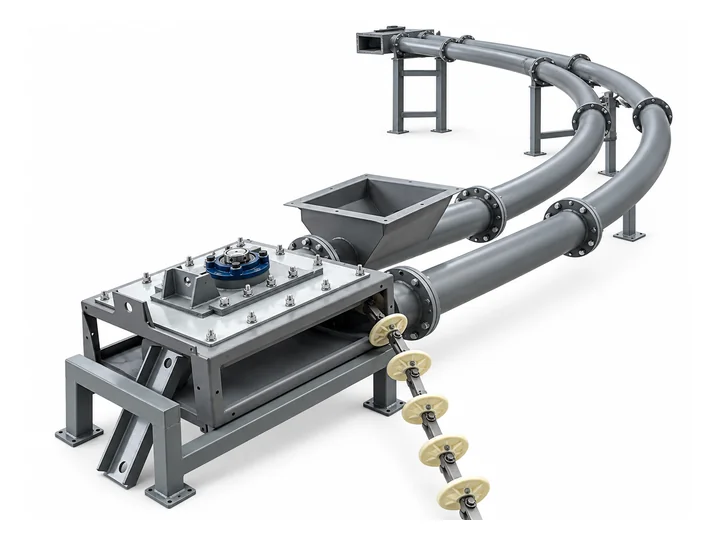
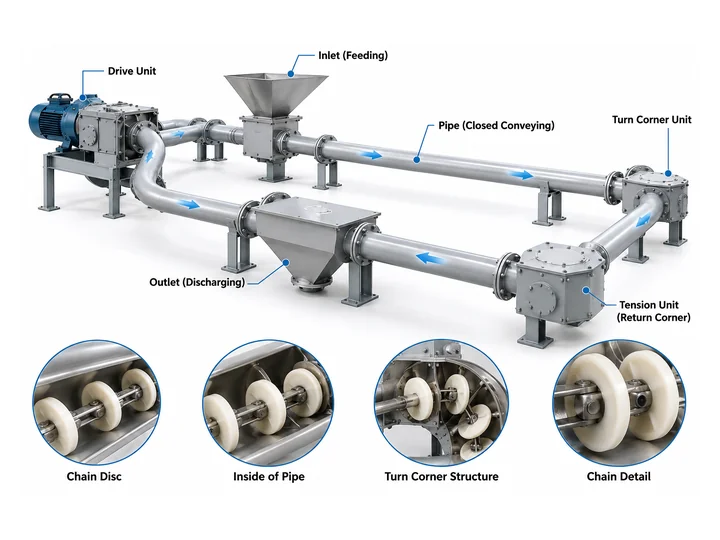
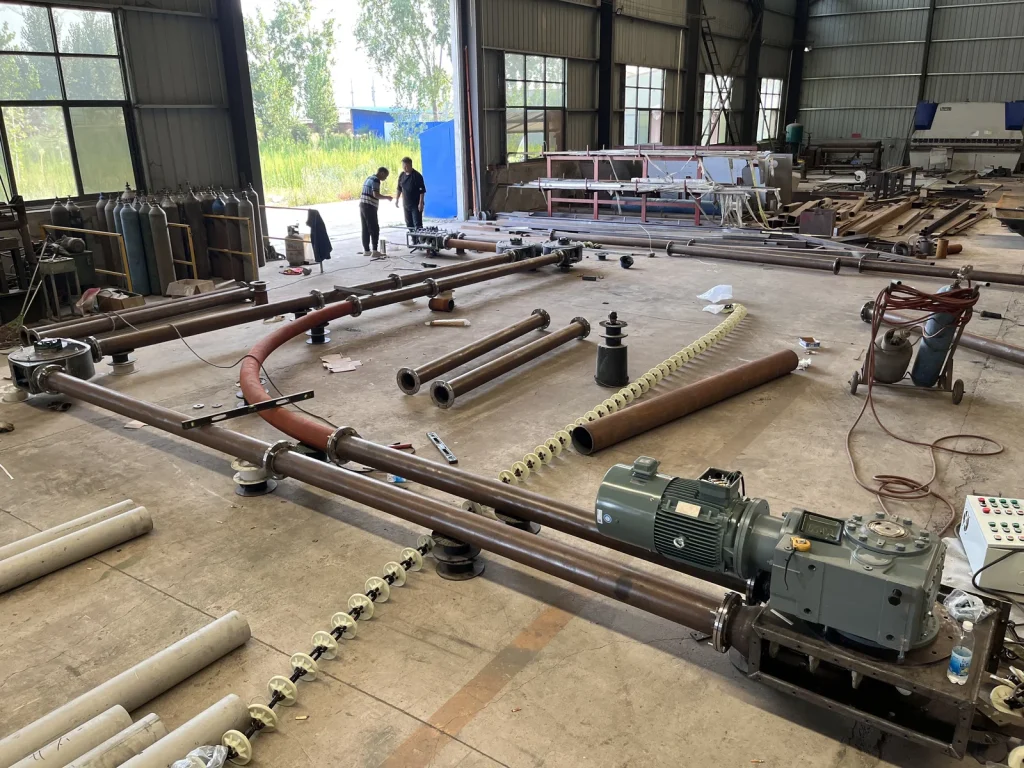
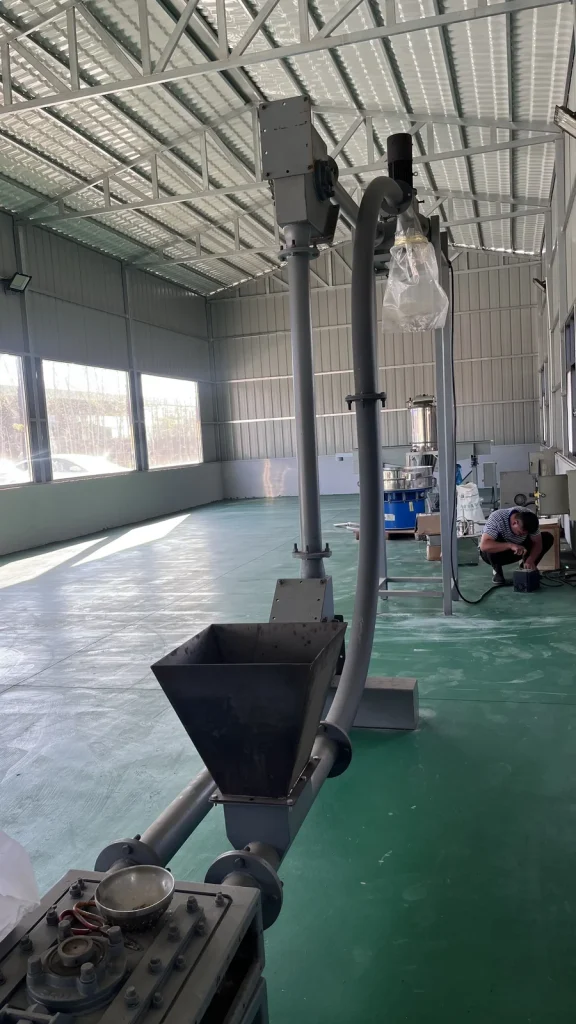
A circulating chain moves conveying discs through straight sections and engineered bends. Material follows the enclosed path to the outlet while the chain returns through its circuit. Bend radius, disc clearance and route resistance determine how the curved layout is arranged.
Selection Factors
- Bend geometry: radius and clearance must suit the selected chain, discs and tube size.
- Route resistance: additional bends change the conveying load and introduce wear locations.
- Access: inspection and cleanout points must remain reachable around equipment and structures.
Suitable Materials for Conveying
The examples below describe dry-solid conveying duties. Powder grade, moisture, contact materials and route loading determine the required configuration. Food and chemical duties need different contact and cleaning arrangements.
Chemical powders & additives 3 examples
Sodium bicarbonate & soda ash
- Material form
- Dry carbonate powders or crystals
- Typical application
- Connect offset additive storage and batching points through fixed bends
- Handling considerations
- Keep moisture out of the inlet; hard lumps can restrict pickup. Select seals and contact surfaces for the actual chemical grade and cleaning method.
Titanium dioxide & iron oxide pigments
- Material form
- Fine pigment powders
- Typical application
- Route pigment powder around existing blending equipment
- Handling considerations
- Fine dust requires sealed feed and receiver connections. Retained pigment at outlets and bends can carry colour into the next batch; provide accessible cleanout points.
Detergent granules & sodium phosphate
- Material form
- Dry formulated granules or chemical powders
- Typical application
- Connect non-aligned additive storage and receivers
- Handling considerations
- Cohesive grades can bridge at the feed hopper. Product temperature and chemical contact govern seal and disc compatibility; enclosure does not remove inlet bridging.
Mineral fillers & building materials 2 examples
Calcium carbonate, talc, kaolin & bentonite
- Material form
- Dry mineral filler powders
- Typical application
- Route filler powder around structural and equipment obstacles
- Handling considerations
- Different powder grades have different bulk density and cohesion. Use controlled inlet loading; inspect dust seals, deposits and wear at bends rather than assigning one rate to every filler.
Cement & dry mineral powder
- Material form
- Dry building-material powders
- Typical application
- Link building-material storage and mixers on an offset route
- Handling considerations
- Exclude wet lumps from the pickup. Abrasion and compacted residues affect the chain, discs and tube; access to the outlet and low points is needed for cleanout.
Plastics & resins 2 examples
PET & other plastic pellets
- Material form
- Free-flowing polymer pellets
- Typical application
- Connect pellet equipment through a defined curved tube circuit
- Handling considerations
- Match disc clearance and inlet loading to pellet size. Bends can generate fines; keep grade-change residues out of the next pellet batch.
PVC & other resin powders
- Material form
- Dry polymer powders
- Typical application
- Transfer resin powder between non-aligned process points
- Handling considerations
- Fine powder needs sealed connections and accessible residue removal. Cohesion, static behaviour and the product contact requirements determine the configured duty.
Grain & food ingredients 2 examples
Wheat, rice & corn
- Material form
- Dry cereal grains
- Typical application
- Move grain around existing equipment to a defined receiver
- Handling considerations
- Foreign objects can interfere with discs and outlets. Control inlet loading and bend contact to limit broken grain; residual grain affects batch separation.
Flour, starch, sugar & salt
- Material form
- Dry ingredient powders or crystals
- Typical application
- Link offset ingredient storage and mixing or packing equipment
- Handling considerations
- Keep ingredient-contact surfaces accessible for cleaning. Flour and starch deposits differ from sugar or salt crystals; moisture, corrosion and crystal breakage require material-specific choices.
Feed & fertilizer materials 2 examples
Animal feed pellets & dry feed ingredients
- Material form
- Formed feed pellets or dry ingredient particles
- Typical application
- Connect feed-processing points around fixed obstacles
- Handling considerations
- Pellet friability and powder carryover affect usable output. Plan emptying and cleaning between formulations; a dust-tight tube alone does not prevent cross-contamination.
Urea & fertilizer granules
- Material form
- Dry prills or formed fertilizer granules
- Typical application
- Route dry fertilizer between non-aligned blending and packing points
- Handling considerations
- Moisture-related caking can obstruct the inlet. Limit impact at bends and discharge points to reduce new fines; contact-material compatibility follows the formulation.
Adsorbents & process additives 1 examples
Activated carbon powder & granules
- Material form
- Fine carbon powder or friable granules
- Typical application
- Connect adsorbent storage to an offset dosing receiver
- Handling considerations
- Powder containment and granule breakage are separate duties. Keep residues accessible for removal; dust properties and area classification determine any required protection measures.
Bend Contact, Wear and Cleanout
Each bend adds contact and an inspection location. Bend geometry, wear and retained product affect the transfer; the fixed route needs accessible cleanout points.
Chemical Powder Conveying: What Changes the Duty
- Dust and colour carryover: seal the inlet and receiver, and keep outlet faces and bends accessible for residue removal. A closed tube does not eliminate pigment remaining from an earlier batch.
- Caking and bridging: moisture or cohesive powder can interrupt supply above the conveying inlet. Control hopper discharge before treating every low-flow problem as a drive problem.
- Contact compatibility: tube, chain, discs and seals all contact the product. Select their materials for the chemical grade, temperature and cleaning exposure; stainless steel alone does not establish compatibility with every chemical.
Common Issues & Checks
- Local wear at bends: inspect abrasive feed, disc condition and the affected tube section after isolation.
- Material buildup: inspect tight changes of direction and outlet emptying; the circuit is a fixed route rather than a freely movable hose.
GL-Series Catalogue Data
View the GL-series parameter table for catalogue capacities and motor ranges. The reference conditions are 1 t/m³ bulk density, 0.3 m/s chain speed and a 0.5 fill factor for conventional dry powders. These are family reference values, not a separately rated duty for this layout.
Useful answers
Frequently asked questions
Is a curved pipe chain conveyor a flexible hose?
No. The tube and bends form a fixed circuit with defined supports and clearances.
Why does bend radius matter?
The chain and discs must pass around each bend without interference. Bend geometry also affects contact, wear and conveying resistance.