Technical resource
GL-Series Tubular Drag Chain Conveyor Specifications and Capacity
GL89 to GL325 tube diameters, volume capacities, lift limits and motor ranges, explained with the LIYOU catalogue reference conditions.
Read the Reference Conditions First
The LIYOU GL-series table states capacity in cubic metres per hour. Its reference conditions are a bulk density of 1 t/m³, chain speed of 0.3 m/s, filling factor of 0.5 and conventional dry powders. These conditions belong with the model data; removing them makes the capacity figures misleading.
GL-Series Technical Specifications
| Model | Tube outside diameter (mm) | Catalogue capacity (m³/h) | Fill factor | Maximum horizontal distance (m) | Maximum vertical lift (m) | Motor power range (kW) |
|---|---|---|---|---|---|---|
| GL89 | 89 | 3 | 0.5 | 45 | 15 | 1.1–11 |
| GL108/133 | 108 | 5–7 | 0.5 | 60 | 20 | 3–15 |
| GL159 | 159 | 10 | 0.5 | 60 | 30 | 3–22 |
| GL219 | 219 | 17 | 0.5 | 60 | 35 | 5.5–28 |
| GL273 | 273 | 30 | 0.5 | 60 | 45 | 5.5–30 |
| GL325 | 325 | 50 | 0.5 | 60 | 45 | 5.5–30 |
Catalogue reference conditions: material bulk density 1 t/m³; chain speed 0.3 m/s; fill factor 0.5; conventional dry powders. Capacity is stated as volume flow, not a material-independent mass rate. Maximum distance, lift and motor-power ranges describe catalogue options; the complete route and material determine the configured duty. The source groups GL108/133 in one row and lists tube OD Φ108 for that row.
Match Tube Size to the Material Stream
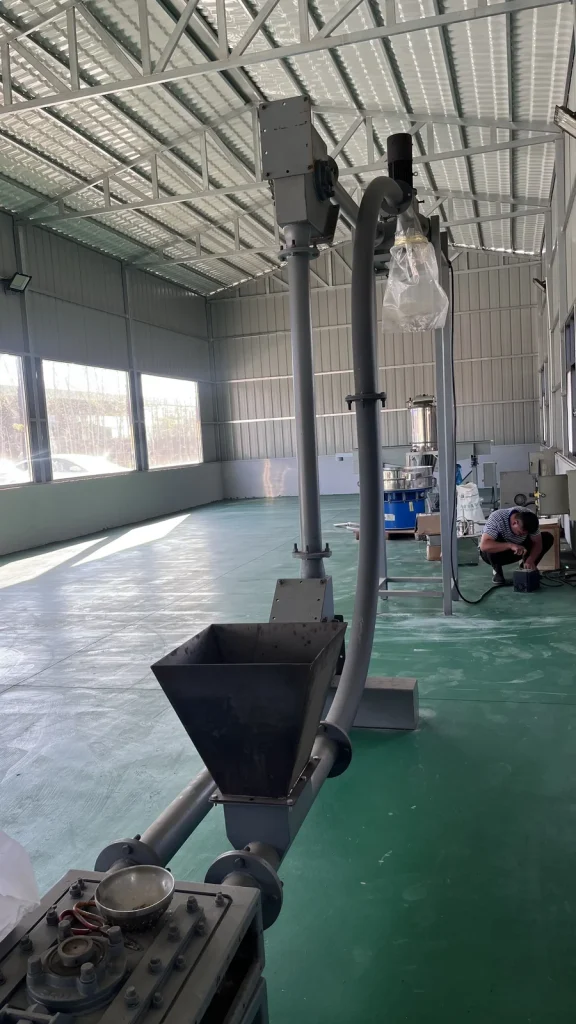
The brochure associates GL89 with small-volume and pilot-scale duties; GL108/133 with small-scale batching and starch; GL159 with grain, calcium powder, plastic pellets and resin powder; and the larger entries with mineral powder, cement, fertilizer and other bulk powders. These are application examples, not fixed capacity ratings for each material.
m³/h and t/h Measure Different Things
Mass flow (t/h) = volume flow (m³/h) × bulk density (t/m³).
At the stated reference density of 1 t/m³, the GL159 table value of 10 m³/h corresponds arithmetically to 10 t/h. That conversion does not establish a guaranteed 10 t/h for every powder: a lower bulk density gives less mass for the same occupied volume, and material flow and route loading can also change the achieved volume rate.
Distance, Lift and Motor Power Describe the Duty
The maximum horizontal and vertical figures are catalogue limits, not confirmation that both maxima are available together on every layout. The complete conveying and return circuit, number of bends, material density and feed loading determine the configured duty.
Motor power is given as a range, from 1.1–11 kW for GL89 to 5.5–30 kW for GL273 and GL325. It is not a single standard motor assigned to each model. Increasing motor power does not change the tube diameter or remove an inlet blockage.
Filling Factor Is Not a Universal Setting
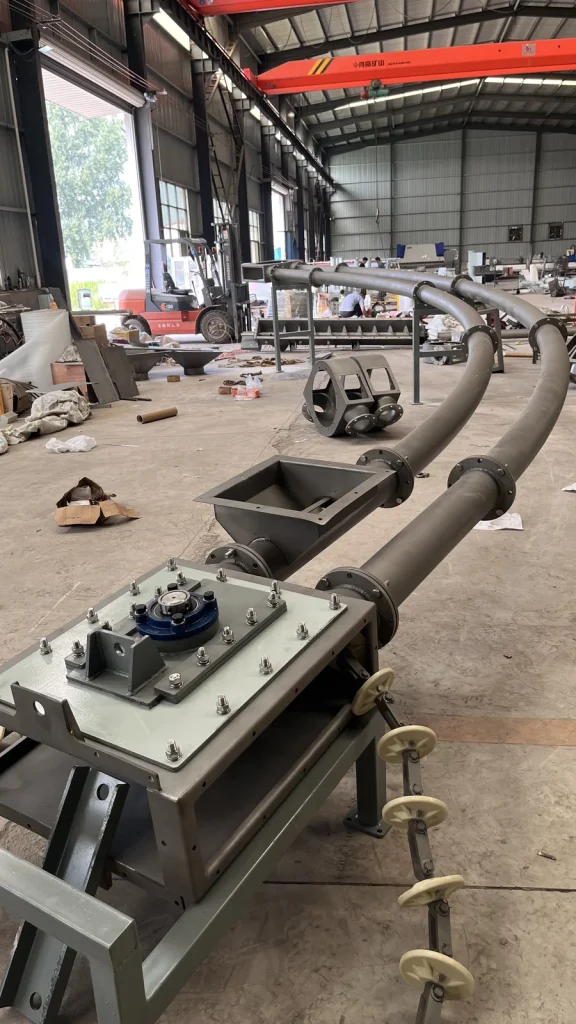
The reference table uses a filling factor of 0.5. The brochure also describes reduced filling in vertical sections to limit material fallback. A combined horizontal and vertical route needs its own loading arrangement instead of assuming the same fill condition everywhere.
Related equipment
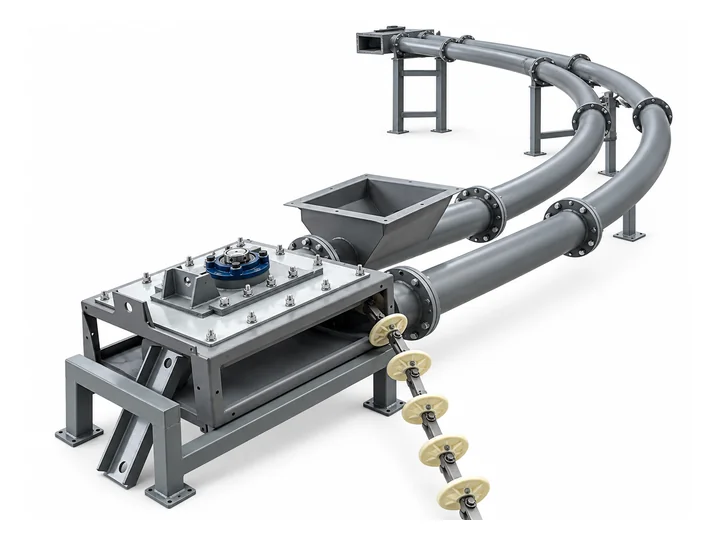
Pipe Chain Conveyor
Transfer chemical powders, food ingredients and plastic granules through an enclosed pipe chain conveyor linking storage, mixing and packing.
Explore equipment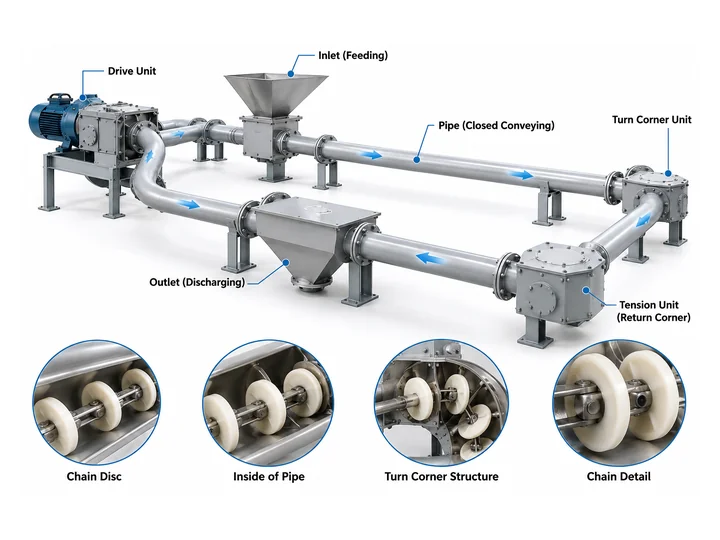
Horizontal Pipe Chain Conveyor
Connect hoppers, mixers and packing stations at similar elevations with a horizontal pipe chain conveyor for enclosed powder and granule transfer.
Explore equipment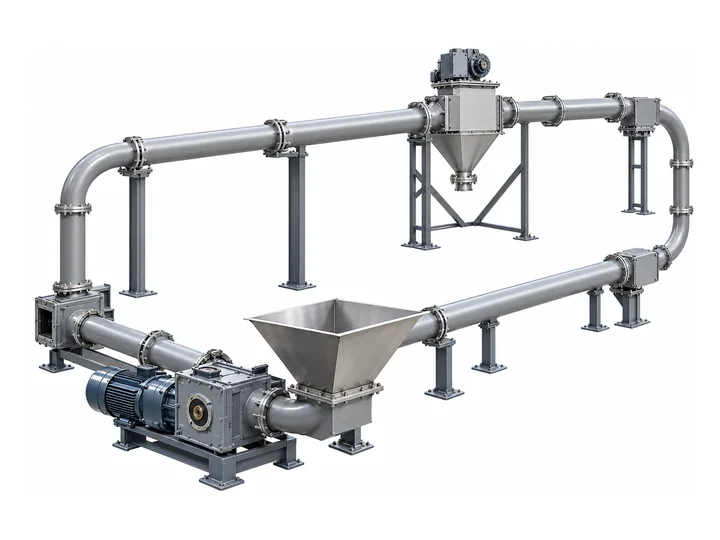
Vertical Pipe Chain Conveyor
Lift dry powders and granules to upper hoppers with a vertical pipe chain conveyor using chain-mounted discs inside a tube.
Explore equipmentCurved Pipe Chain Conveyor
Route dry powders and granules around fixed plant equipment with a curved pipe chain conveyor using engineered tube bends.
Explore equipmentTechnical resources
How Tubular Drag Chain Conveyors Move Powders and Granules
How tubular chain conveyors handle chemical powders, mineral fillers, resins, grains and ingredients, with practical dust, wear and cleanout conditions.
Read guide