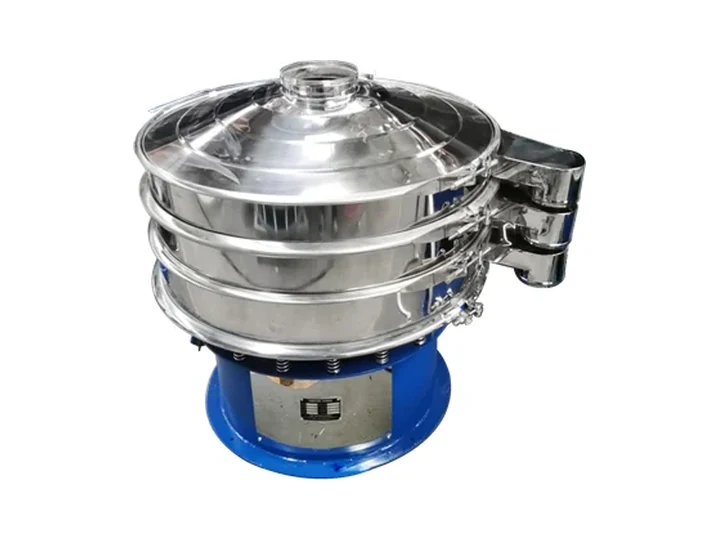
Rotary Vibrating Screen
Remove lumps and grade powders with a rotary vibrating screen for flour, starch, mineral fillers and chemical ingredients.
Explore equipmentIndustry solution
Remove oversize from flour and starch, grade sugar and salt, and transfer dry ingredients between sieving, blending and packing.
Discuss your application ↗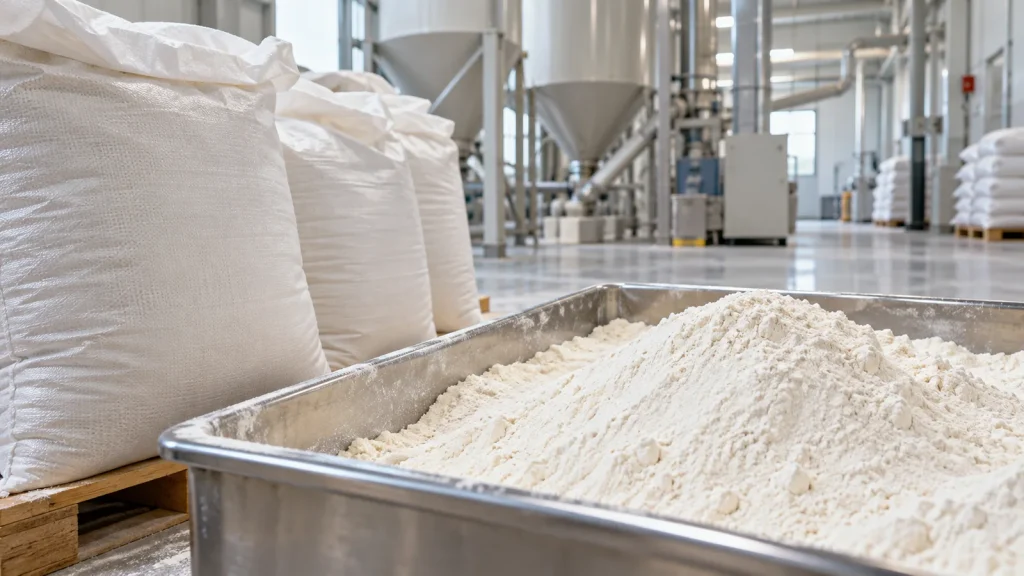
Flour screening protects the next mixing or packing stage by retaining material larger than the sieve opening. Sugar grading divides crystals into saleable size fractions. Starch screening removes agglomerates from a fine powder. These jobs need different screen openings and outlet arrangements: one reject outlet for check screening, separate collection points for each grade when classifying crystals. A size screen cannot remove a contaminant that is smaller than its opening.
Sugar crystals roll and spread readily when dry, while flour and starch can form a cohesive bed. Powdered seasoning may contain fibrous particles that bridge openings. Damp salt cakes and can stick to the mesh. A deep powder bed hides the lower layers from the screen, so a steady inlet stream matters more than simply increasing vibration. Spread the feed across the active area rather than dumping a bag onto one spot.
| Material / observation | Separation / cause | Equipment / action |
|---|---|---|
| Wheat flour | Remove oversized agglomerates and size-retained foreign matter before mixing. | Rotary or direct-discharge sifter |
| Corn starch / potato starch | Separate lumps; keep fine mesh open when powder coats the wires. | Rotary screen with suitable mesh cleaning |
| Granulated sugar | Separate coarse crystals and fines into distinct outlets. | Tumbler or gyratory screen |
| Salt / powdered seasoning | Break the screening duty down into oversize removal or particle-size grading. | Rotary or tumbler screen |

When fine particles coat the wires, the effective open area falls. Good powder then travels to the reject outlet without passing through. Stop and inspect the mesh for coating, damage and loose tension. Clean or replace the assembly before altering the screen setting. Soft lumps and fibrous ingredients may need a mechanical mesh-cleaning arrangement; ultrasonic mesh cleaning addresses fine-powder adhesion on compatible screens. Neither approach makes a wet or sticky ingredient behave like a dry free-flowing powder.
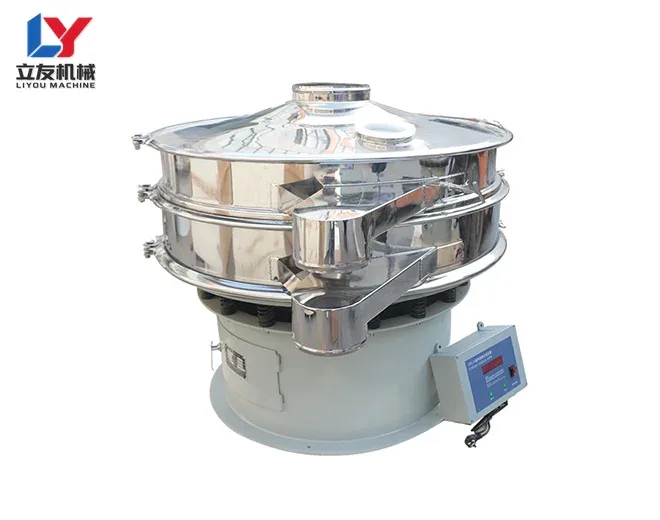
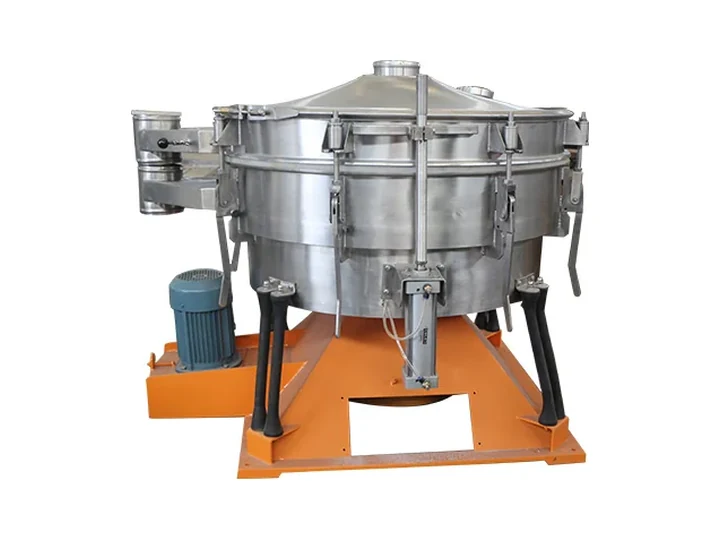
A rotary vibrating screen provides compact check screening and can separate more than one size fraction with multiple decks. A direct-discharge sifter gives the accepted ingredient a short downward route where the installation needs vertical feed and discharge. A tumbler screen is used for fine grading with several separate fractions. Keep rejects isolated from accepted ingredients; do not return everything from the reject outlet to the mixer without identifying it.
A screw conveyor moves flour or starch over short enclosed routes and can provide a controlled inlet stream when designed as a feeder. A bucket elevator lifts a suitable dry ingredient between floors. Covers alone do not remove residue: product-contact surfaces, seals, joints and discharge pockets must be accessible for cleaning. During ingredient changeovers, inspect retained powder at the outlet and under the mesh. Where allergens are handled, cleaning effectiveness is verified by the plant cleaning procedure rather than by the appearance of stainless steel.
Remove lumps and grade powders with a rotary vibrating screen for flour, starch, mineral fillers and chemical ingredients.
Explore equipmentClassify fine powders and delicate granules with a tumbler screen, using extended mesh contact to separate closely sized fractions.
Explore equipmentKeep fine-powder screening openings clear with an ultrasonic vibrating screen for coating powders, mineral fillers and other cohesive dry powders.
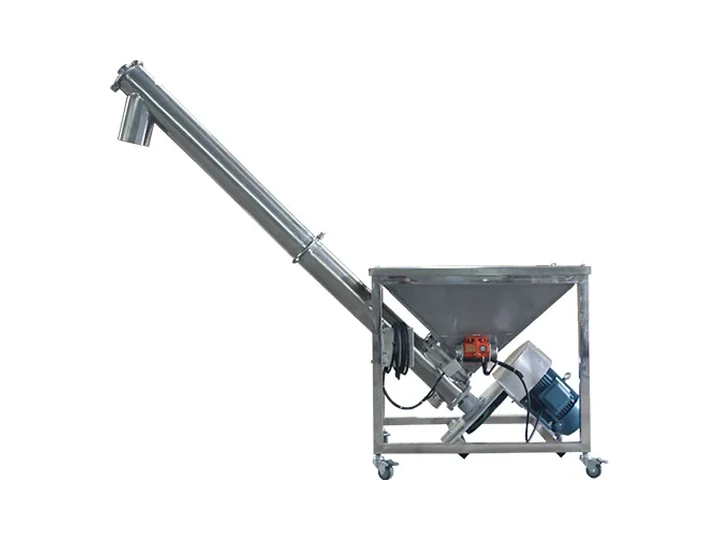
Explore equipmentTransfer dry powders and granules between hoppers, mixers and packing equipment with a screw conveyor sized for the feed and incline.
Explore equipment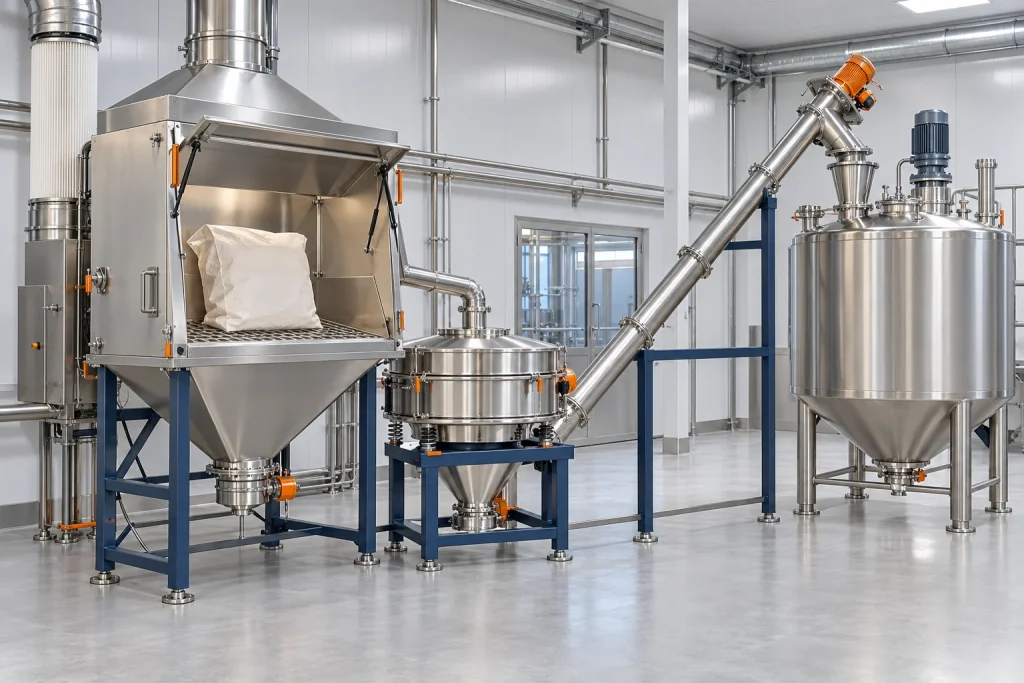
Application concept
What flour screening removes, how blocked mesh sends usable flour to rejects, and where to inspect the sieve before blending.
Read guideUseful answers
No. It retains particles larger than the screen opening. Smaller contaminants need other controls such as magnets or metal detection where appropriate.
Check for mesh coating, excessive bed depth, uneven feed, wrong aperture and a blocked accepted-product outlet.
Start with your material
Share your material, throughput and process requirements. We will review the details needed for equipment selection.